You can stay on-message while being off-camera
It is true that video clips often produce more social media engagement than text or audio. But those statistics largely reflect mass-market behaviour across all users, not necessarily the habits of executives, professionals or specialized B2B audiences. Or just people who are busy and increasingly conscious about the drawbacks of screen time.
For business communications specifically, our leaders and experts routinely tell us they have limited time, limited budgets and little interest in turning every media project into a video production.
The good news is that you can expand your reach and accomplish leadership marketing goals while leaving your camera off. Video makes sense when a creative production has retail or mass-market goals requiring maximum exposure. For professional communications, the objective is often different: reach the right audience, communicate a complex idea clearly and make the content easy to consume.
Audio Driving Podcasting Popularity
Podcast listening in Canada continues to grow, while audio remains the natural format for much professional podcast consumption. That distinction matters because professional audiences rarely consume business content under ideal viewing conditions. They listen in the car, on public transit, while walking, exercising or completing routine work.
According to the Triton Digital report, weekly podcast listening among Canadians grew to about nine episodes in 2025. Despite this growth, the majority of high-impact business and public affairs podcasts are still mostly consumed in audio only.
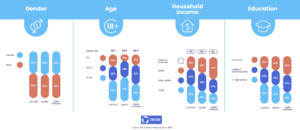
Additionally, multiple data sources reveals that high-income earners are significantly more likely to consume audio podcasts over video; the trend is observed by measuring household income itself, as well as age, education level and the platform used (iPhone use is correlated with higher income brackets).
For organizations trying to reach executives, advisors and other professionals, attention quality may be more important than raw impressions. A smaller group that listens closely to a 30-minute discussion can be considerably more valuable than a much larger group that encounters a short video while scrolling.
Efficiency Amid Uncertainty
CEOs and senior executives have been stretched thin in recent years. Leadership teams are leaner, executive time is expensive and communications departments are under pressure to produce more with fewer resources.
Under those conditions, video adds preparation, lighting, visual presentation, retakes, editing and additional review. Audio still requires professional production, but generally involves fewer moving parts and can be produced effectively through a remote studio.
Another risk is delay. A remote podcast interview can be recorded without dispatching a production crew or coordinating a physical shoot. That makes recurring executive content considerably easier to sustain.
Video also introduces a series of decisions that have little to do with the underlying idea: sets, wardrobe, lighting, visual continuity, camera angles and B-roll.
For thought leadership, those decisions should support the argument rather than consume the project.
Conversion to News Media
One overlooked advantage of audio-first content is its flexibility.
A professionally produced interview can become a podcast episode, radio segment, transcript, article, newsletter feature or a series of short promotional clips. One substantive conversation can therefore support several editorial formats without asking the executive to repeat the same exercise.
For many B2B leaders, unless video is essential to the message — a product demonstration or architectural walkthrough, for example — the added production requirements may not be necessary.
As more communications move into newsletters, podcasts and other direct channels, audio offers a useful combination of control, depth and portability.
During remote recording sessions, we still recommend leaving the camera on between participants. Seeing one another generally produces a more natural conversation, even if the audience ultimately hears only the audio. Short video excerpts can also be captured when useful for social media promotion.
For professionals deciding where to invest, our default recommendation is simple: build the editorial product around audio, then add video when it solves a specific communications problem.
The objective is not maximum reach at any cost. It is credible ideas, delivered efficiently to the audiences that matter.
Photo: Joshua Hoehne / Unsplash